What will the precision steel tube industry look like in the next few years?
For OEM manufacturers and industrial buyers, the answer is becoming increasingly important. Precision steel tubes are no longer viewed simply as standard metal components. As automotive, automation, smart office equipment, and advanced machinery continue to evolve, manufacturers are demanding tighter dimensional control, better consistency, more flexible customization, and greater production efficiency.
Recent industry developments point toward stronger demand for cold-drawn tubes in applications where dimensional accuracy and repeatability are important. Automotive manufacturers, for example, are investing in expanded seamless and cold-drawn tube capacity for applications requiring precise and consistent tubular components.
So, what are the major trends shaping the future of precision steel tube manufacturing?
Search Intent: What Are Buyers Looking for in the Future?
When international buyers search for a precision steel tube manufacturer, they are increasingly looking beyond today's product specifications.
They want to know whether a supplier can support future product development, maintain stable quality as tolerances become tighter, provide customized dimensions, and adapt production to increasingly automated manufacturing environments.
The question is therefore shifting from:
“Can you manufacture this steel tube?”
to:
“Can you continuously manufacture this steel tube to the same specification as our product requirements evolve?”
This shift is particularly relevant to OEM customers, whose products may undergo several design improvements during their lifecycle.
Problem: Precision Requirements Are Becoming More Demanding
Modern manufacturing leaves less room for dimensional variation.
As equipment becomes more automated, components need to fit together more consistently. A small variation in tube diameter, wall thickness, straightness, or surface condition can create problems further down the production line.
At the same time, customers are looking for lighter and more efficient products without sacrificing structural performance.
This creates a difficult balance for steel tube manufacturers:
higher precision + stable quality + customized specifications + competitive cost.
Traditional production methods focused primarily on volume are not always sufficient for these requirements.
The future of precision steel tube manufacturing will therefore depend increasingly on manufacturers' ability to combine material expertise, process control, advanced equipment, and application knowledge.
Solution: From Conventional Tubes to Intelligent Manufacturing
One major trend is the continued development of cold drawing technology.
Cold drawing can improve dimensional accuracy, surface quality, and consistency, making it particularly suitable for applications where tighter tolerances are required. Current industry discussions also point toward greater automation, process monitoring, and more predictable production as important directions for tube drawing technology.
The next stage is not simply about producing more tubes. It is about producing more consistent tubes with better process visibility.
Automation and digital production can help manufacturers monitor manufacturing conditions, reduce variation, and improve production efficiency. For OEM buyers, this means greater confidence that the specification agreed during development can be maintained during mass production.
Another important trend is application-driven customization.
Instead of purchasing a standard tube and modifying it extensively afterward, more manufacturers are looking for suppliers that can provide tubes closer to the requirements of the final product.
This approach can reduce secondary processing and help OEM customers improve overall manufacturing efficiency.
The Rise of Application-Specific Precision Steel Tubes
The future market for precision steel tubes is likely to become increasingly specialized.
Automotive applications require different performance characteristics from hydraulic systems. Electric lifting columns have different requirements from industrial machinery. Smart office products may prioritize dimensional consistency and smooth telescopic movement, while other applications may place greater emphasis on strength, surface finish, or corrosion resistance.
This means the role of the precision steel tube manufacturer is changing.
A supplier is no longer simply expected to manufacture according to a standard specification. Increasingly, buyers want a manufacturing partner that understands how the tube will be used inside the finished product.
For OEM procurement teams, this can make technical communication and customization capability just as important as production capacity.
Brand Proof: Where Huagang Intelligent Fits
Huagang Intelligent is developing its precision steel tube business around this shift from commodity manufacturing toward application-focused solutions.
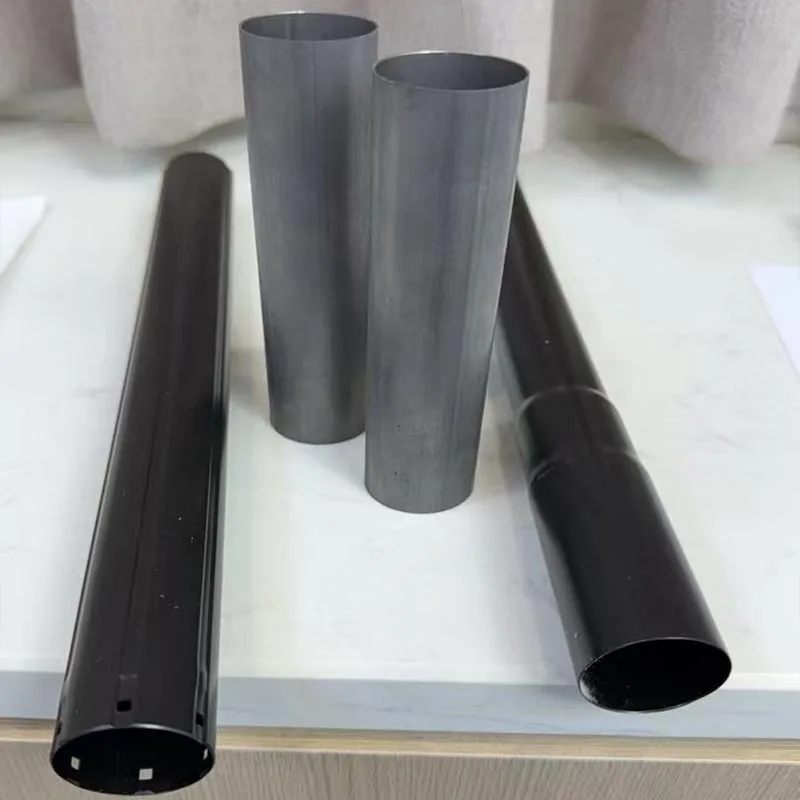
A key feature of the company is its use of automotive-grade precision cold-drawn steel tubes for electric lifting columns.
This creates a direct connection between precision steel tube manufacturing and smart office products, where dimensional consistency and smooth interaction between telescopic sections are important.
Huagang Intelligent combines precision steel tube manufacturing with downstream electric lifting column and standing desk frame production. This gives the company practical experience in understanding how tube specifications affect finished products.
The company also supports OEM and ODM customization, allowing international customers to develop precision steel tubes according to specific materials, dimensions, tolerances, lengths, surface requirements, and downstream processing needs.
For buyers, this application-oriented approach can be more valuable than simply choosing a supplier based on standard catalog products.
What Will Define the Next Generation of Steel Tube Suppliers?
The future supplier will need to do more than manufacture steel tubes.
They will need to provide precision, consistency, customization, process control, and technical support.
Quality management will also remain central. ISO describes quality management as a framework for consistently delivering products that meet customer and applicable requirements, while emphasizing process control, performance evaluation, and continual improvement.
For precision steel tube buyers, this means supplier evaluation is likely to become increasingly focused on the entire manufacturing system rather than a single product sample.
The strongest suppliers will be those capable of connecting:
raw material → manufacturing process → precision control → inspection → customization → final application.
The Future Is Precision + Flexibility
The future of precision steel tube manufacturing is not simply about making steel tubes thinner, stronger, or more accurate.
It is about making the manufacturing process more consistent, intelligent, flexible, and application-focused.
As OEM products become more specialized, manufacturers will increasingly need suppliers that can move beyond standard specifications and participate in product development.
For Huagang Intelligent, this means continuing to develop precision steel tube capabilities while connecting them with electric lifting columns, smart office products, automotive applications, and other precision-driven industries.
For international buyers, the right supplier is therefore not necessarily the largest manufacturer. It is the partner that can understand your application, control the manufacturing process, support customization, and maintain consistent quality as your product evolves.
Looking for a Future-Ready Precision Steel Tube Partner?
If you are developing automotive components, electric lifting columns, smart office products, industrial equipment, or other precision applications, Huagang Intelligent can provide customized precision steel tube solutions based on your technical requirements.
Share your drawings, material specifications, dimensions, tolerances, application requirements, and expected purchasing volume with the Huagang Intelligent team.
The future of steel tubes is not just higher precision—it is smarter manufacturing built around real product requirements.